A note to Kojak Nation – if you’d like to receive an email notification when new blog posts are available, use the Contact page to send Kojak a note and we’ll add you to the list!
It’s now been two full weeks since Kojak, our young Rottweiler, had his knee repaired with TPLO surgery, and we’re beginning to settle into a new routine. If you missed the first week of his recovery, you can read about it in Kojak Recovers From TPLO Surgery – Week 1.
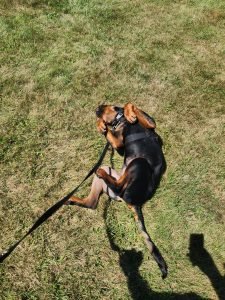
The second week of Rottweiler TPLO recovery has been less about the surgery itself and more about one very big challenge: keeping an energetic young Rottweiler from doing all the things he’s absolutely not supposed to do. If you missed the post on what TPLO surgery is all about, take a look at Kojak is Getting Ready for TPLO.
After surgery, Kojak can’t be allowed to run loose outside, play with his toys, or go up and down stairs. Before surgery, he did all of those things every day. He IS still considered a puppy, after all! But for now, we have to temporarily restrict his activities and give his leg time to heal. According to the surgeon, the hardware she put in his leg is as strong as it will ever be. What takes time is allowing the bone to heal around the hardware.
And patience is not exactly Kojak’s strong suit.
The hardest part of TPLO recovery for Kojak? No toys!
Probably the hardest thing for Kojak is not being allowed to play with his toys. He loves to chew on a toy, pick it up and carry it around, then run and pounce on it almost like a cat. We tried giving him a chew toy or a bone. He’d gnaw on it for a little while, but within about 20 minutes or so he’d be galivanting around the house with the toy in his mouth—dropping down to chew it, dragging it around, and pouncing on it.
Sadly, the only time he can really be trusted is when he’s in his pen, which limits his mobility. And even then, I sit next to the pen just to keep an eye on him.
Keeping an energetic young Rottweiler quiet during TPLO recovery is proving to be quite a challenge!
Watching Kojak’s leg during recovery
We’ve been keeping a close eye on the swelling in his surgical leg. At first, it seemed to swell to almost twice its normal size. Thankfully, after about five days, the leg was almost back to normal size. We’re also trying not to make the mistake of thinking normal size means completely healed. Kojak still has a long way to go before that leg is ready to return to normal activity.
How is Kojak using his leg two weeks after TPLO surgery?
Kojak uses his surgical leg when he’s walking around and uses it just fine for, er, elimination. When he’s outside and pulling on the leash—there’s a whole story behind those so-called no-pull harnesses—he uses all four legs to get extra traction. When he’s standing still, however, he tends to keep that foot off the ground or, at most, just touch his toes to the ground. When he’s walking normally—not pulling, which is apparently a completely different activity—he does limp a bit on that leg, especially when he first starts walking. As he walks, his gait smooths out and the limp becomes much less noticeable.
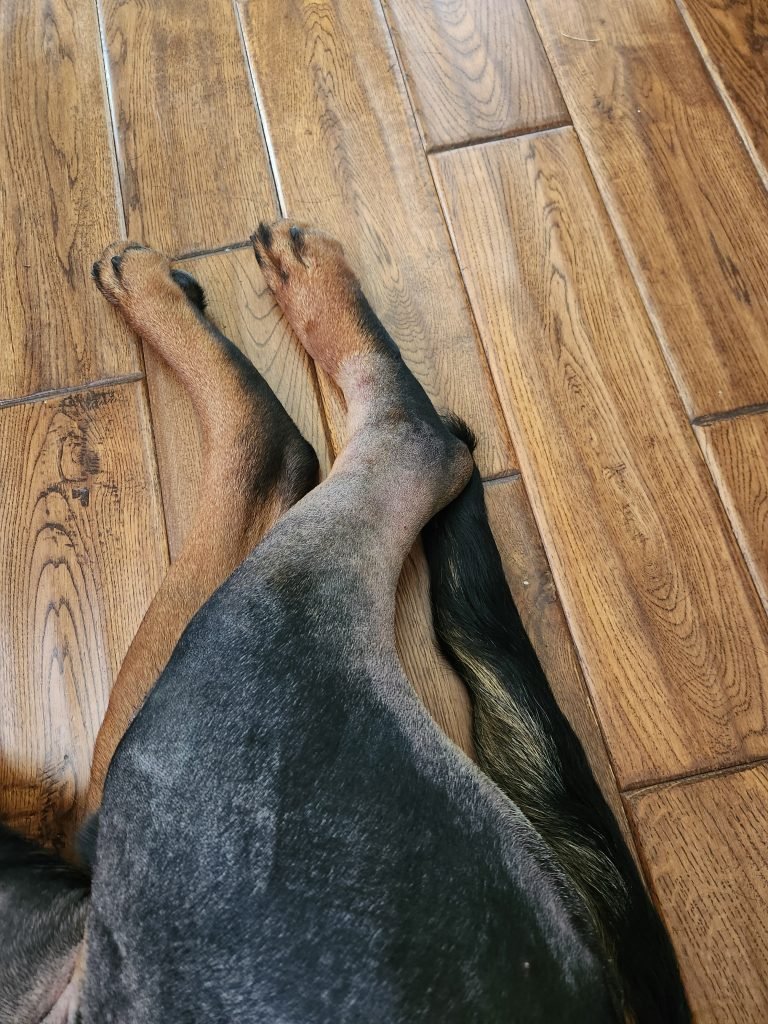
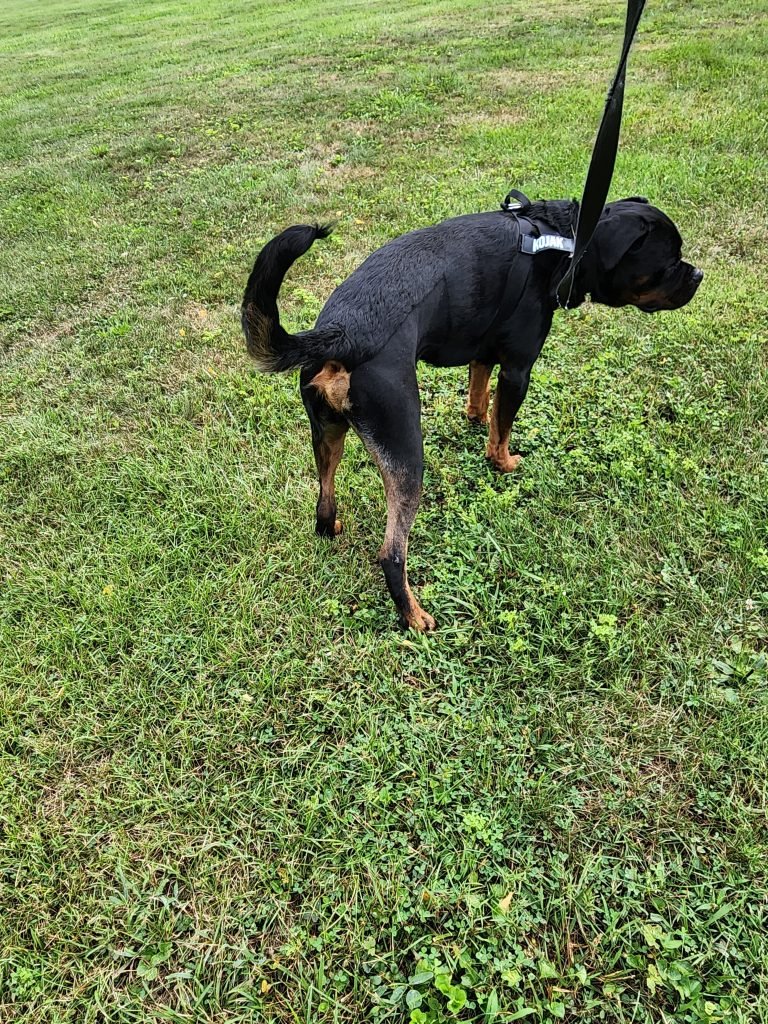
The surgeon’s assistant assured me that this is normal and that it takes time to bounce back after TPLO surgery.
For us, the biggest lesson so far is that seeing Kojak use the leg doesn’t mean he’s ready to start doing everything he used to do.
Keeping a Rottweiler quiet after TPLO surgery – Good Luck!
The irrepressible Kojak gets very excited when we have guests in the house or when we take him on an outing to the vet. And when Kojak gets excited, he jumps – a lot. And he puts his weight into it – imagine over 100 pounds of Rottweiler jumping on you, or pulling the leash in your hand. Jumping is expressly verboten while recovering from TPLO surgery. He’s also not supposed to jump onto furniture or go up or down flights of more than three stairs.
Of course, Kojak said he didn’t read the post-surgery instructions.
On one occasion, he noticed there was an empty space on the couch. Before we could grab him, he sailed right over the coffee table and claimed his position on the couch. On another occasion, we had him in his pen in the basement when there was a fumble on the catch for the gate and it unexpectedly opened. Kojak the opportunist crashed through the gate and literally flew up the basement steps—probably even faster than he did before surgery!
Unfortunately, I think these incidents, along with a couple of jumping episodes, may have irritated his leg a bit because afterward he seemed to be toe-touching more than he had been.
There’s only so much we can do. I can’t wrestle a 15-month-old Rottweiler to the ground every time he decides to launch himself at something.
The Cone of Shame Saga
And then there’s the cone.
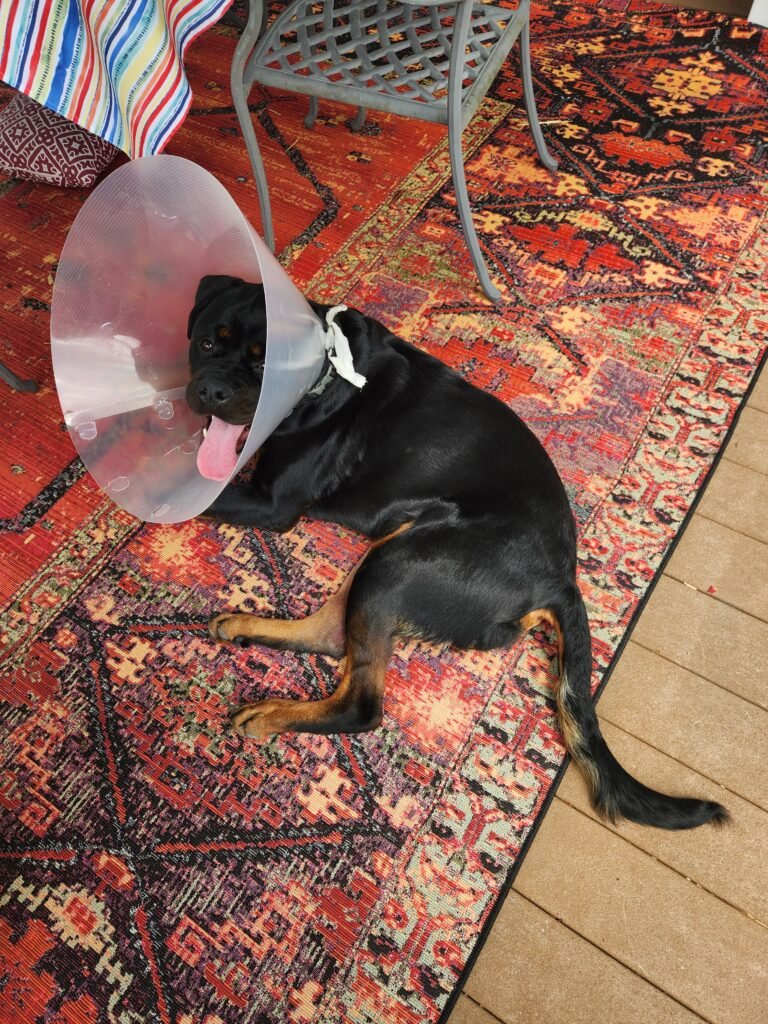
Kojak hates the “cone of shame”. Literally hates it. He’s already chewed through two of them and is currently working on his third. At this rate, I’m going broke buying cones! At one point, Libby had taken him for a walk (we usually take the cone off for walks and eating) and Kojak saw his mortal enemy (the cone) sitting on a chair. Before Libby could grab the cone, Kojak snagged it in his mouth and started prancing around the house with his trophy. He would stop and drop to chew it a bit, then as soon as she got close, he jumped up and resumed tearing around the house. She finally managed to bribe him with some treats and get the cone back – and back on him!
The cone is also the source of some of his jumping antics. He’ll jump around in a circle like he’s trying to catch his tail. Then he’ll lie down, roll over with his legs kicking in the air, jump back up and turn around the other way—all in an attempt to catch a piece of the cone. Once he succeeds, he’ll lie down with his head between his paws and use his front paws to press against the side of the cone, creating a ridge between his paws. Then he’ll squirm forward until he can grab that ridge with his teeth.
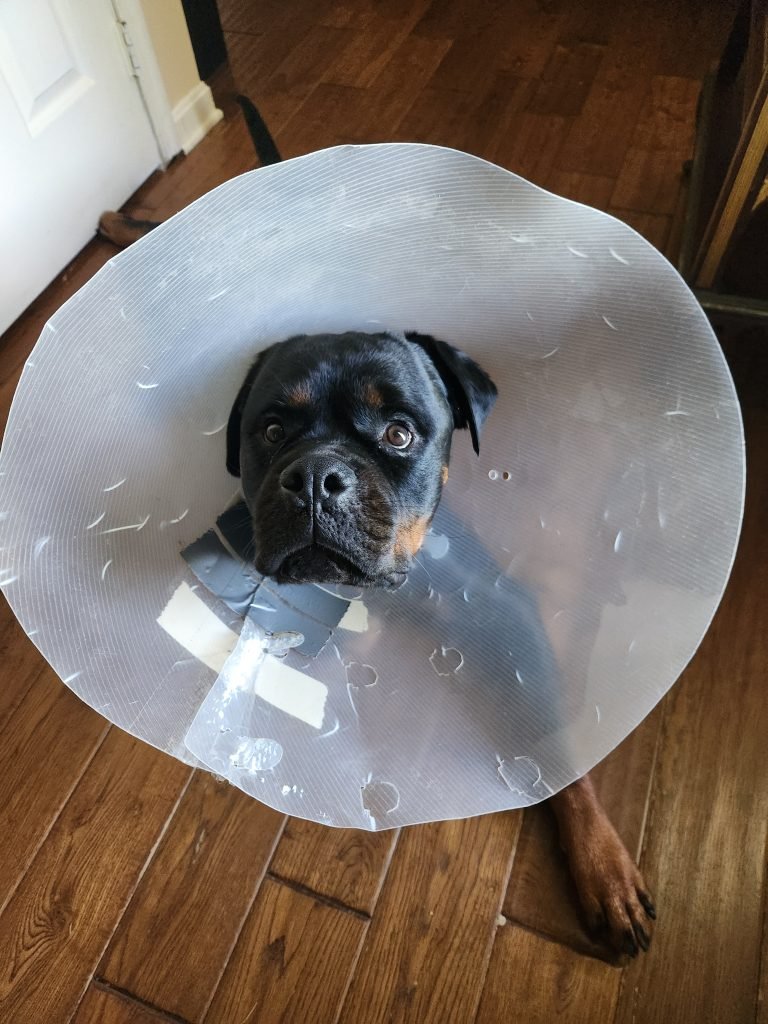
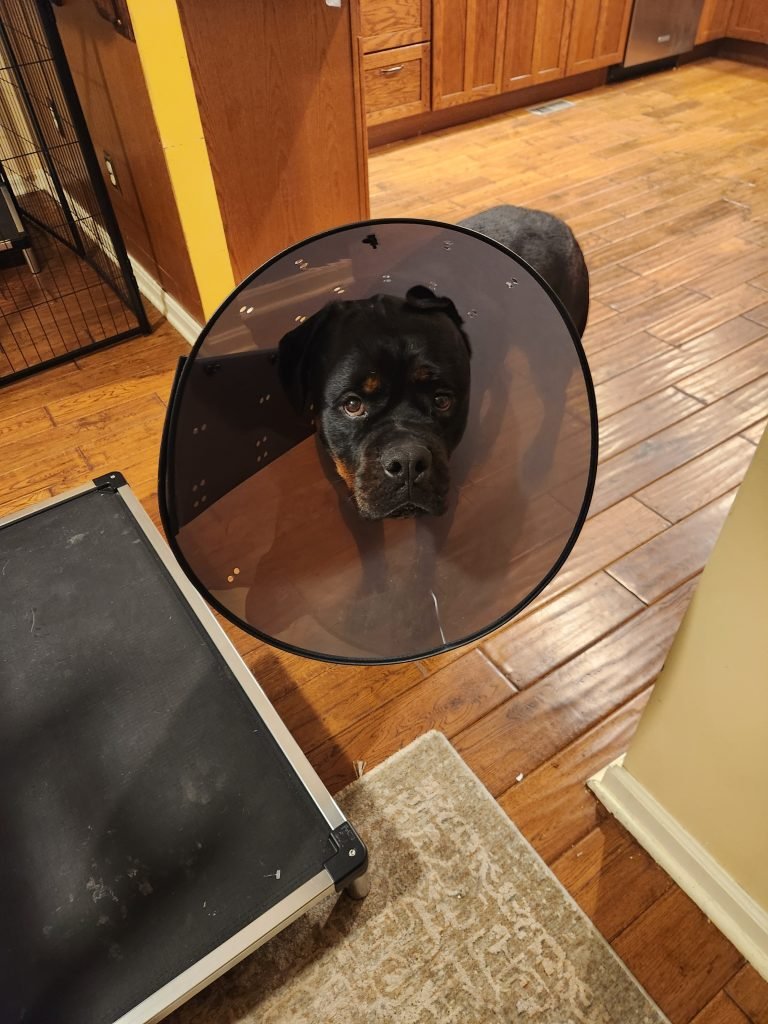
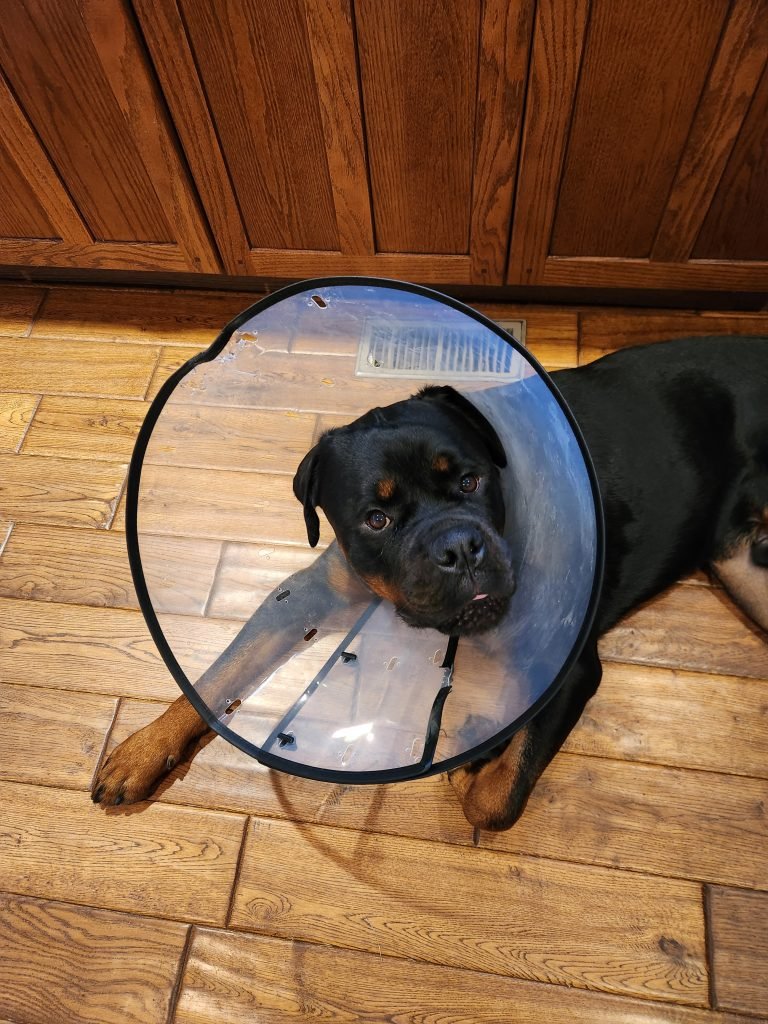
And the chewing commences.
It’s actually pretty impressive.
Unfortunately, it’s also exactly the kind of activity we’re trying to prevent while his knee heals. If you’re dealing with a Rottweiler going through TPLO recovery, I suspect you’ll understand why “keep the cone on” can be considerably easier said than done.
Fortunately he only has to wear the cone until his stitches come out. After the suture removal, three more days of cone then that part’s done. Sutures are scheduled to come out in the middle of week 3 so we’ve got about 6 more days of cone follies.
Stay tuned for the final cone score!